Poultry House Fan Selection: Why Diameter and Rated Airflow Are Not Enough
When poultry farms compare exhaust fans, the first numbers on the table are usually fan diameter, motor power and rated airflow. It is an understandable shortcut. A larger fan with a higher catalogue airflow looks like the stronger choice.
The problem is that poultry houses do not operate under catalogue conditions.
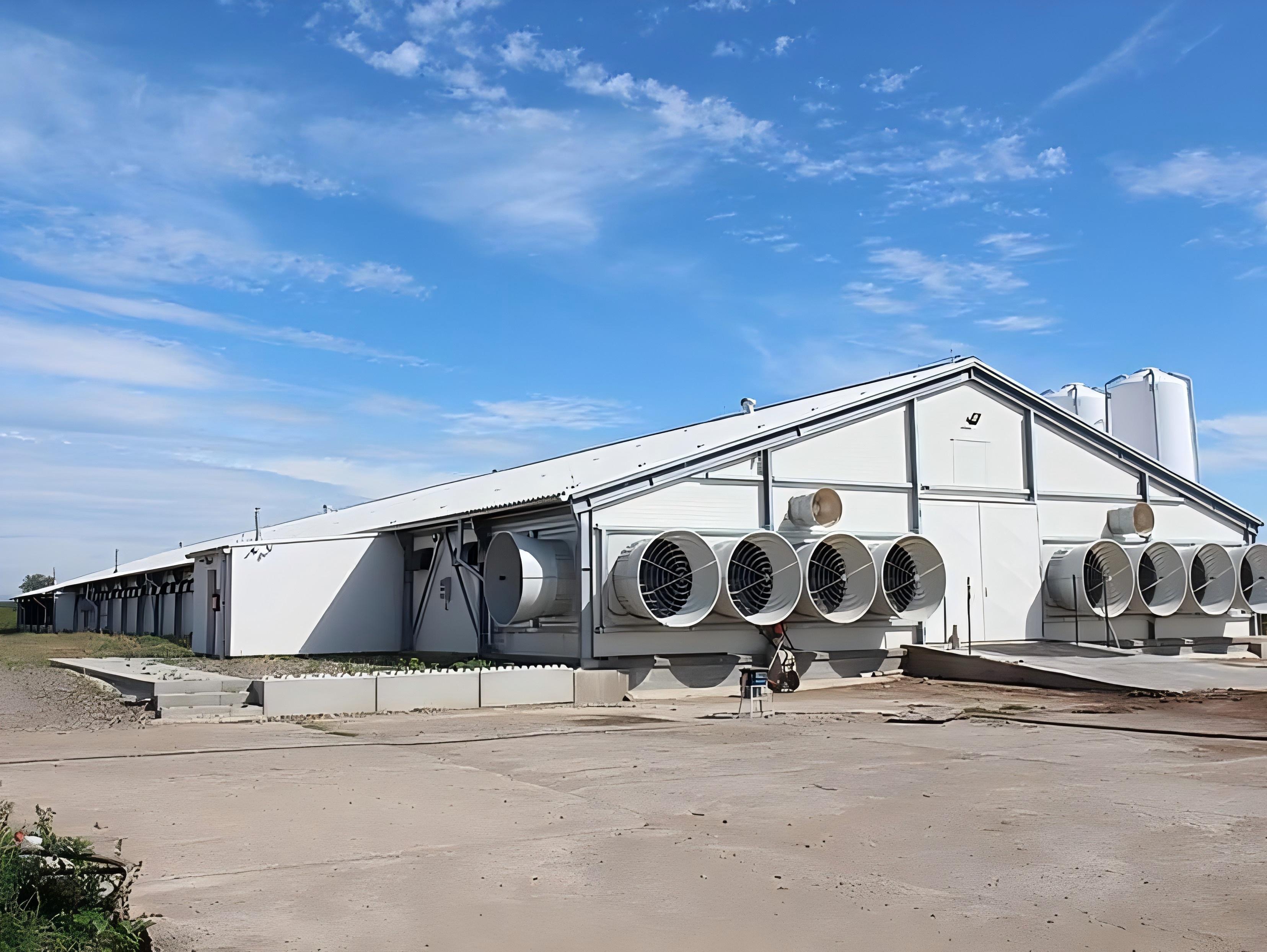
Once a fan is installed, air has to move through shutters, guards, cones, cooling pads, air inlets and the building itself. Shutters, guards, cones, cooling pads and designed air inlets create system resistance. Building tightness and uncontrolled leakage determine where replacement air enters and how pressure and airflow are distributed through the poultry house. Together, these factors create system static pressure. A fan that looks impressive at zero resistance can deliver much less useful airflow after it is installed in a real house.
For that reason, the real question in poultry house fan selection is not simply, 'Which fan has the biggest number on the brochure?' It is, 'How much air will this fan actually move at the pressure this poultry house will operate under?'
Rated Airflow Is Only a Starting Point
The airflow figure printed on a product sheet is normally measured under a defined test condition. In many catalogues, the headline value is the maximum or near-zero-static-pressure airflow. That number is useful for identifying the general size of the fan, but it should not be treated as the airflow the farm will automatically receive after installation.
For the wider planning sequence, review our poultry-house ventilation design and equipment-selection guide before comparing individual fan models.
Real poultry ventilation includes resistance from several components. A shutter that does not open fully adds pressure loss. A safety guard restricts part of the flow area. A cone changes the pressure-performance behaviour of the fan. Cooling pads and inlets add resistance on the intake side. Leakage through doors, wall joints or other openings changes how the house develops negative pressure.
The result is simple: actual fan performance has to be checked at the expected static pressure, not only at the peak airflow printed in a sales brochure.
If buyers select fans only from rated airflow, the system can look strong on paper and still fail to reach the required airspeed inside the poultry house after commissioning.
Compare Different Fans at the Same Static Pressure
When several suppliers are being compared, the test condition needs to be the same. Otherwise, the numbers are not directly comparable.
Ask for airflow, input power and operating efficiency at several static-pressure points. Noise data can also be compared when it is available, but again, the test condition and measurement standard should be clear.
Buyers should confirm whether the published fan curve was tested with the shutter, cone, guard and production motor configuration that will actually be supplied. Where applicable, request the declared test standard, laboratory and complete test configuration. ISO 5801 or ANSI/AMCA 210/ASHRAE 51 may provide a recognized basis for aerodynamic performance testing, but a product should not be described as tested or certified to a standard without documentary evidence.
This is especially important for large broiler and layer houses. The design is not based on one fan. The project needs a total exhaust-airflow target, an effective ventilation cross-section and a target airspeed inside the house. Those values then determine how many fans are required and how much performance margin should be reserved.
The margin matters. Fans do not stay factory-clean forever. Dust builds up. Shutters become less free. Components age. If the design only works when every fan is new and perfectly clean, the farm has very little tolerance for real operating conditions. Performance margin should be defined against the project duty and risk strategy. It should not be replaced by an arbitrary percentage without documented design assumptions.
Poultry Fan Supplier Comparison Matrix
| Comparison Item | Supplier Data to Request | Acceptance Rule |
|---|---|---|
| Fan model and diameter | Identify the exact model and supplied size. | Model and configuration are unambiguous. |
| Test standard and laboratory | Request declared method, report and laboratory. | Document supplied; no certification inferred. |
| Airflow at 0 Pa | Record m³/h or cfm and the test configuration. | Unit and condition stated. |
| Airflow at project static pressure | Compare all fans at the same Pa or in. w.g. point. | Same pressure and air-density basis used. |
| Electrical input power | Record W/kW at the same operating point. | Complete fan input basis stated. |
| Airflow per watt | Calculate only from aligned test data. | Unit shown; no mixed conditions. |
| Voltage and frequency | Confirm destination supply and motor configuration. | Ordered configuration matches site. |
| Shutter included in test | Confirm shutter type and position. | Included/excluded clearly marked. |
| Cone and guard included | Confirm all resistance-producing accessories. | Test and supplied configurations reconciled. |
| Motor and control configuration | Record motor, speed setting and control mode. | Compared fans use declared production setup. |
50-Inch and 57-Inch Fans Are Not Simply Small and Large Versions
One candidate is the 50-inch butterfly cone fan for commercial poultry ventilation; confirm its model-specific curve and supplied configuration against the project duty. A 50-inch butterfly cone fan is a practical choice for many medium and large broiler houses, layer houses and other poultry buildings with moderate to high ventilation demand. In the configuration described in our project planning, the fan uses a corrosion-resistant housing and a direct-drive permanent magnet motor. A direct-drive arrangement also removes the belt-slippage and belt-maintenance issues found on traditional belt-driven fans.
For higher peak-capacity duties, review the 57-inch high-capacity poultry fan for heavy ventilation loads at the same project static-pressure condition. For very large poultry houses, or projects in hot regions where peak summer heat removal is much more demanding, a 57-inch high-airflow cone fan can provide a larger airflow platform. The larger impeller and heavier-duty structure are intended for high ventilation loads during the most demanding part of the production cycle.
But these two sizes should not be treated as a simple 'small fan versus big fan' choice. A project may use one size, the other, or a combination, depending on house length and width, stocking density, target bird-level airspeed, design static pressure and the total number of fan positions available. Selecting the largest fan first and calculating the system afterward reverses the correct design process.
Both sizes are candidate configurations. Final selection should follow the required airflow at the project operating pressure, available fan positions, electrical conditions and control strategy rather than fan diameter alone.
50-Inch vs 57-Inch Poultry Fan Selection
| Comparison Item | 50-inch | 57-inch |
|---|---|---|
| Typical role | Standard/intermediate high-capacity candidate. | Higher peak-capacity candidate. |
| Potential application | Medium/large projects may evaluate. | Large or demanding peak-duty projects may evaluate. |
| Fan grouping | May offer more staging combinations. | May reduce peak-capacity positions, subject to layout. |
| Static-pressure performance | Verify model-specific curve at project pressure. | Verify model-specific curve at project pressure. |
| Electrical requirement | Confirm supplied motor, voltage and control. | Confirm supplied motor, voltage and control. |
| Final selection rule | Use project airflow, pressure, positions and control strategy. | Do not select by diameter alone. |
Fan Sealing Can Affect Ventilation in Both Summer and Winter
Sealing performance is easy to overlook during purchasing because it is not as visible as fan diameter or motor power. Over a full year of operation, however, it has a direct effect on ventilation stability.
When a fan is off, butterfly doors or shutters should close properly. If they leak, cold air can enter the poultry house during winter minimum ventilation. That can disturb the planned inlet pattern and increase heating demand.
The opposite problem occurs when the fan is running but the shutter cannot open completely. The partially closed opening becomes extra resistance and reduces actual airflow.
Poultry houses also expose fan components to humidity, dust and ammonia. Corrosion can make shutter mechanisms stiff over time. This is why corrosion resistance is not only about appearance. It helps determine whether the fan can continue opening, closing and moving air consistently after several production cycles.
Direct drive eliminates one maintenance point, but it does not eliminate maintenance itself. Fan blades still need cleaning, and shutters and moving parts still need inspection.
Variable-Speed Control Matters in Modern Poultry Houses
For automated poultry houses, the fan control interface should be considered during selection rather than after the fans arrive on site.
Permanent-magnet variable-speed fans that support 0-10V analogue control or RS485 communication can receive commands from a compatible environmental controller. Depending on the system design, operating status can also be returned to the controller.
Environmental sensors provide measurements to the compatible poultry environmental controller. The controller evaluates those measurements and sends the required speed or operating command to the fan.
An RS485 label alone does not confirm full compatibility. Buyers should request the protocol or register map, communication parameters, supported read/write functions and communication-failure behaviour. For 0–10V control, confirm signal scaling, minimum operating command, electrical isolation and the required failure-state logic.
That gives the farm more control than a traditional fan that can only switch fully on or fully off. During seasonal transition, night-time low-load operation or brooding, the ventilation requirement may be well below full summer capacity. Variable-speed control allows airflow to be adjusted more finely as environmental demand changes.
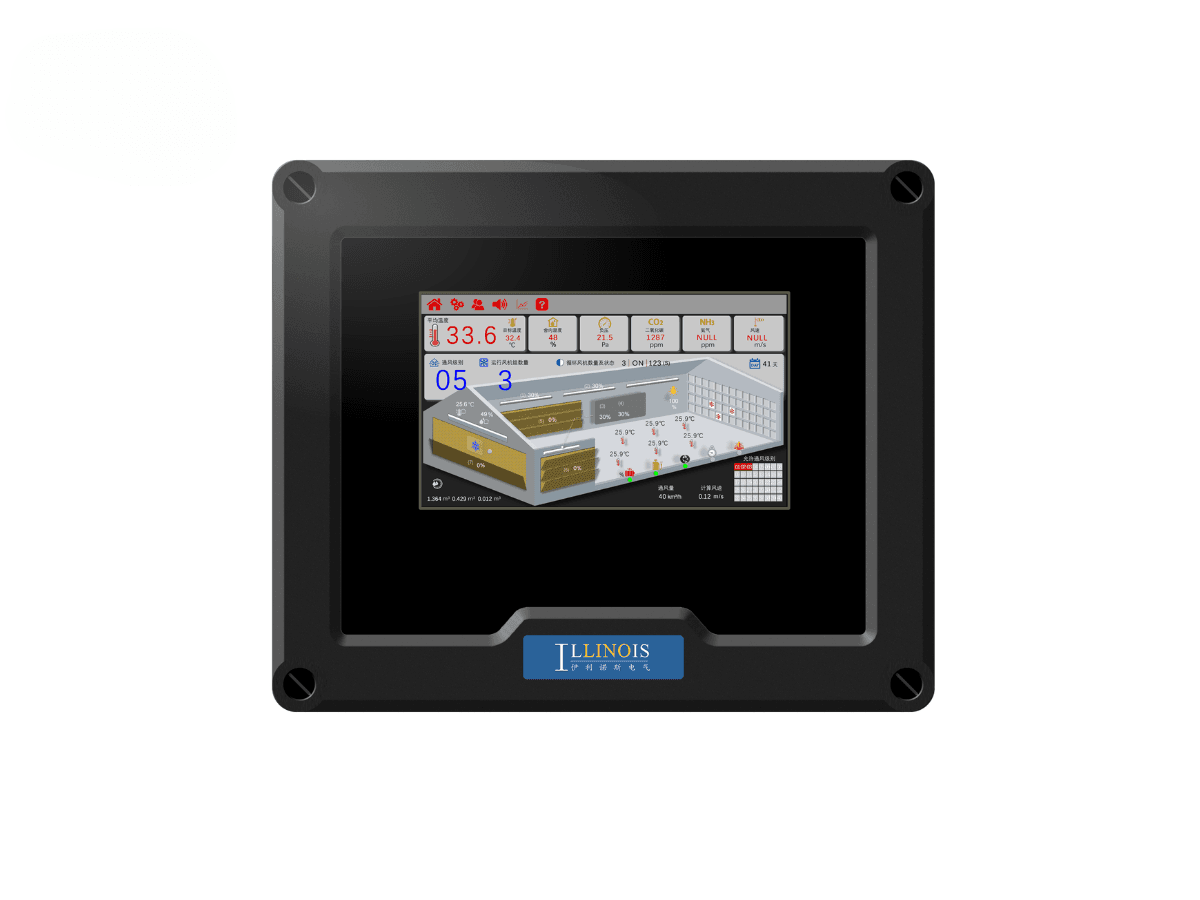
Where the approved I/O and control interfaces match, a LINO Touch MAX controller for staged and variable-speed ventilation can be reviewed for the project. Projects requiring broader staged-control capacity can also review the LN-9900 controller for large poultry-house ventilation systems, subject to the approved equipment and I/O schedule.
For retrofit, minimum-speed and communication considerations, see our EC motor guide for demand-based poultry ventilation.
Before ordering, the buyer should confirm the communication method, supply voltage, protection level and insulation requirements against the local electrical system. The fan supplier should also be able to explain how the fans will interface with the proposed poultry environmental controller.
Hot-Climate Projects Should Be Checked Against the Worst Operating Condition
For a poultry project in a hot climate, the ventilation check should be based on the most demanding realistic condition, not on an average day.
That means looking at peak summer outdoor temperature and the period when birds are at or near their maximum body weight. The design should still have enough capacity to meet the ventilation target after allowing for reasonable performance loss from dust and normal ageing.
Once the number of fans is determined, the electrical side needs another check. Available power capacity, fan-group control logic and backup arrangements all have to support the ventilation design.
A mechanically correct ventilation calculation can still fail as a project if the electrical system cannot start, control or protect the required fan groups when they are needed most.
Long-Term Maintenance Is Part of Fan Selection
Many purchasing comparisons stop at airflow, power and price. Long-term ventilation performance depends just as much on whether the equipment can be maintained properly.
Before installation, the project should consider access for cleaning and service. Common spare parts should be identified. A simple maintenance record is also useful for larger farms.
Instead of writing only 'fan cleaned' in a maintenance log, the farm can record operating current, house negative pressure and measured airspeed before and after cleaning. Over time, those figures show whether the ventilation system is drifting away from its original performance.
A new fan reaching its design target on the first day is not difficult. The real test is whether the system can still deliver stable, controllable ventilation after multiple complete production cycles.
A Practical Fan Selection Process for Large Poultry Houses
A sound fan-selection process starts with the poultry house, not the product catalogue.
· 1. Calculate the maximum summer heat-removal airflow and the minimum winter ventilation requirement.
· 2. Define the ventilation mode and the target operating static pressure.
· 3. Calculate the total fan quantity required at that pressure.
· 4. Match the 50-inch, 57-inch or mixed fan configuration with the automation and control strategy.
After that, compare supplier performance data under the same static-pressure conditions. Confirm that resistance from shutters, cones, guards, wall openings and other system components has been considered. Then review the electrical supply, communication interface, maintenance access and backup strategy.
This sequence is less convenient than choosing the fan with the largest catalogue airflow, but it is far more likely to produce the ventilation performance the poultry house actually needs.
What Buyers Should Ask a Poultry Fan Supplier
Before placing an order, professional buyers should be able to get clear answers to a few practical questions:
· What airflow does the fan deliver at the static pressure expected in my house?
· What are the corresponding input power and efficiency values?
· Are the shutter, cone and guard included in the published performance data?
· Which fan size is recommended for my house dimensions, stocking density and target airspeed?
· Does the fan support 0-10V or RS485 control, and which poultry controllers are compatible?
· What voltage, protection and insulation options are available for the destination market?
· What routine cleaning, shutter inspection and spare parts should be planned over the fan's service life?
These questions reveal much more about real project suitability than a single rated-airflow figure.
Frequently Asked Questions
Is a larger poultry fan always better?
No. A larger diameter may provide more airflow potential, but the useful result depends on the fan's performance at the system static pressure, the house dimensions, target airspeed and total ventilation design.
Why can installed airflow be lower than catalogue airflow?
Shutters, guards, cones, cooling pads and designed inlets create resistance, so the fan operates at a static-pressure point rather than at the low-resistance condition used for a headline airflow figure. Building leakage can also change where replacement air enters and how useful airflow is distributed.
Should I choose a 50-inch or 57-inch cone fan?
Treat both sizes as candidate configurations. Compare model-specific airflow at the project operating pressure, available fan positions, electrical supply and control strategy before selecting the final combination.
What performance data should I request before comparing suppliers?
Request airflow, electrical input power and airflow-per-watt data at the same static-pressure points. Confirm the test standard, laboratory, air-density basis, speed, voltage and whether the shutter, cone, guard and production motor configuration were included.
What information should I send to a poultry fan supplier?
Provide the poultry-house dimensions, bird type and capacity, expected final bird weight, local peak summer temperature, target bird-level airspeed, expected static pressure, cooling-pad or inlet arrangement, available fan positions, voltage and frequency, and the existing controller model. Drawings and installation photos can also help the supplier review the project configuration.
Select the Fan for the Poultry House, Not the Brochure
Professional ventilation design is not about selling the biggest fan. It is about making sure the installed equipment can continue delivering the air exchange the birds require under the real resistance conditions of the poultry house.
For system-level airflow distribution after fan selection, use our broiler tunnel ventilation guide for airflow, airspeed and commissioning.
If you are planning a new broiler or layer house, or reviewing an existing tunnel-ventilation system, the useful starting information is the house dimensions, stocking density, local summer conditions, target airspeed and planned fan positions. From there, the 50-inch and 57-inch cone fan options can be matched with the required airflow, static pressure and automation strategy.
Discuss Your Poultry Fan Selection Requirements
Share the poultry-house dimensions, bird type and capacity, local peak summer temperature, target airspeed, expected static pressure, available fan positions, supply voltage and existing controller model. We can then review the suitable 50-inch or 57-inch fan configuration for the project.
Product Categories
Recommended Products
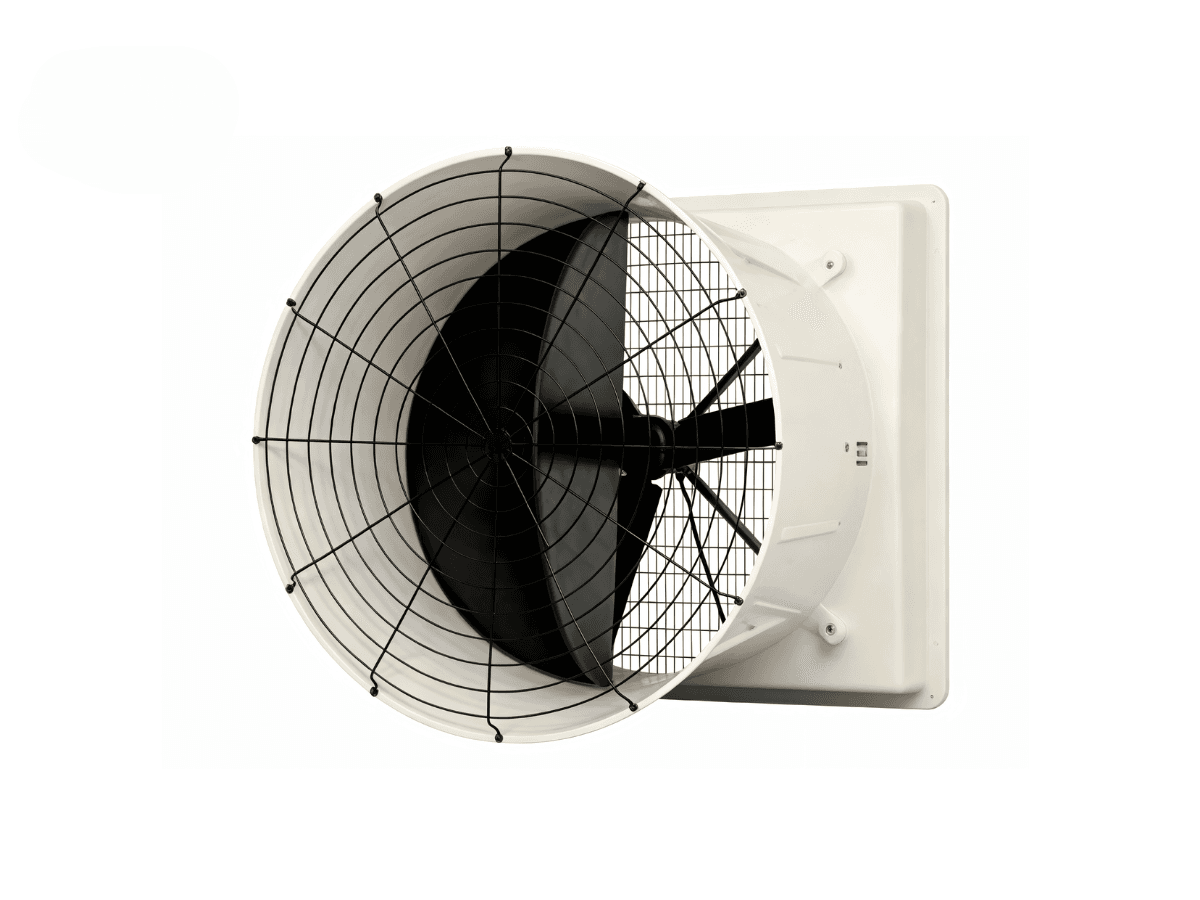
50-inch Butterfly Cone Ventilation Fan with PM Motor for Livestock and Poultry Farms
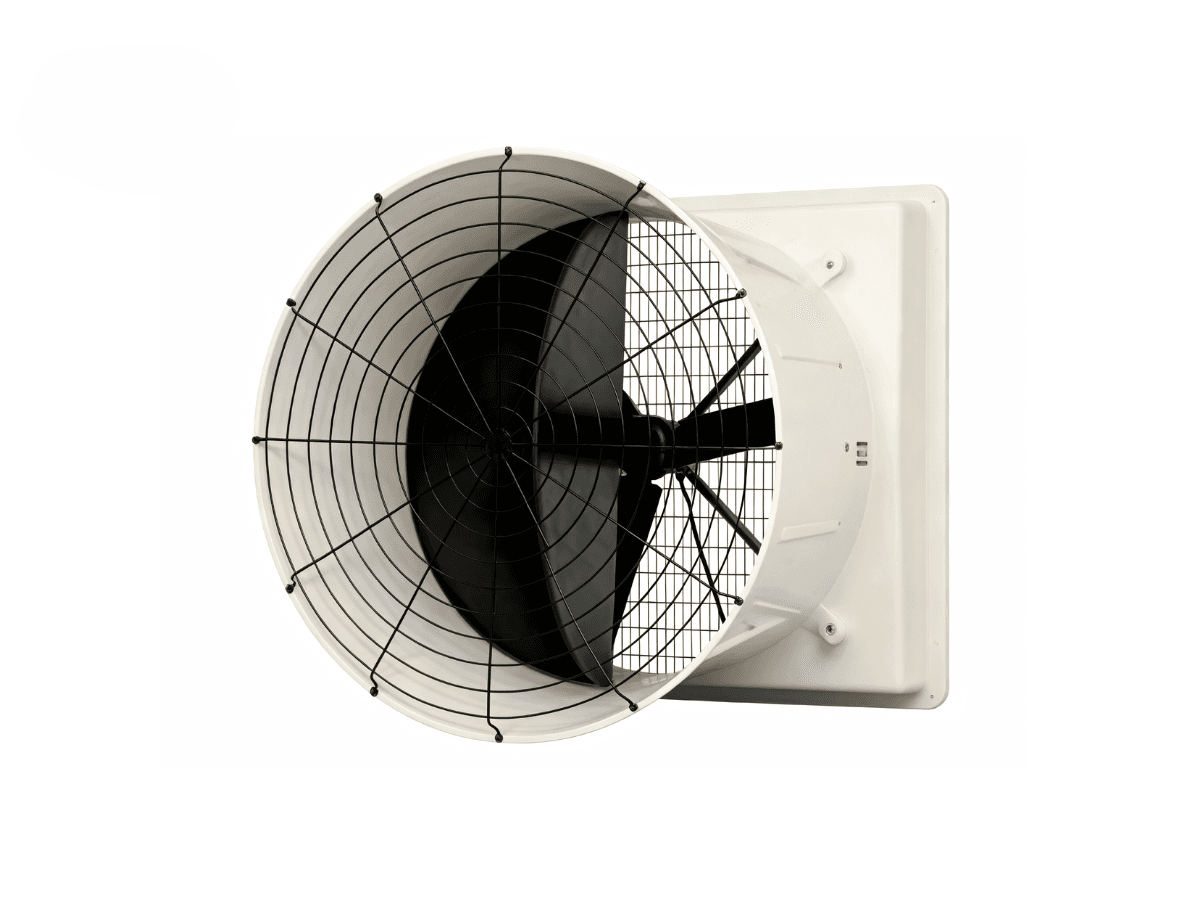
57-inch High-Capacity Butterfly Cone Ventilation Fan with PM Motor for Livestock and Poultry Farms
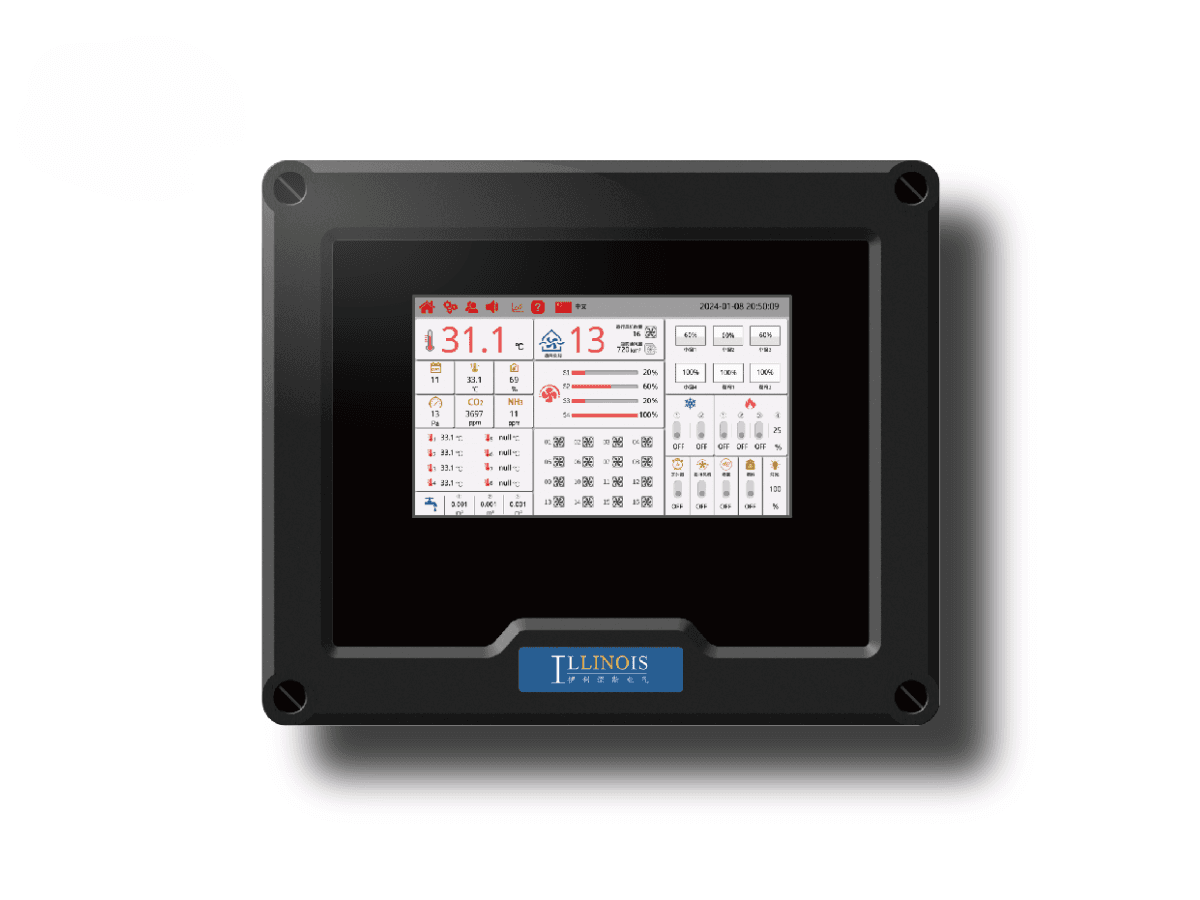
LINO Touch MAX Intelligent Poultry Environmental Controller